






Complex formulations, fluctuating demand and shorter product life cycles call for flexible tablet presses. With the i Series, Fette Compacting offers a platform for applications ranging from small batches to high-output production. The F20i and F30i can also be connected to the FE CPS continuous processing system. A new powder transfer system is used for this purpose, addressing even the challenge of continuously feeding powder to the F30i double rotary tablet press.
Changing demands in tablet production pose several challenges for pharmaceutical manufacturers: they must process different batch sizes economically, switch between products frequently and ensure consistently high quality. Rigid system concepts quickly reach their limits. “What manufacturers need above all are platforms that can adapt to new requirements and be expanded step by step as needed,” says Lisa Taetz, Strategic Marketing Manager at Fette Compacting. This is the approach behind Fette Compacting’s i Series, which comprises three tablet presses for different production scenarios: the F10i for small batches, the F20i as a versatile all-rounder and the F30i as a high-output double rotary tablet press. Together, they form a platform that supports both conventional batch processes and Continuous Direct Compression.
Output tailored to the production target
A key advantage of the i Series is its combination of high output and flexible use. Pmax® rotor technology, FS12 punches and a special segment design, for example, accommodate a large number of punch stations without changing the pitch circle diameter. Depending on the application, this can increase output by up to 40 percent. In this configuration, the F20i achieves an output of up to 475,200 tablets per hour, while the F30i double rotary tablet press produces up to 1.58 million tablets per hour. “This allows the i Series to cover a very broad range without requiring manufacturers to switch to a different machine concept for every new production requirement,” says Lisa Taetz.
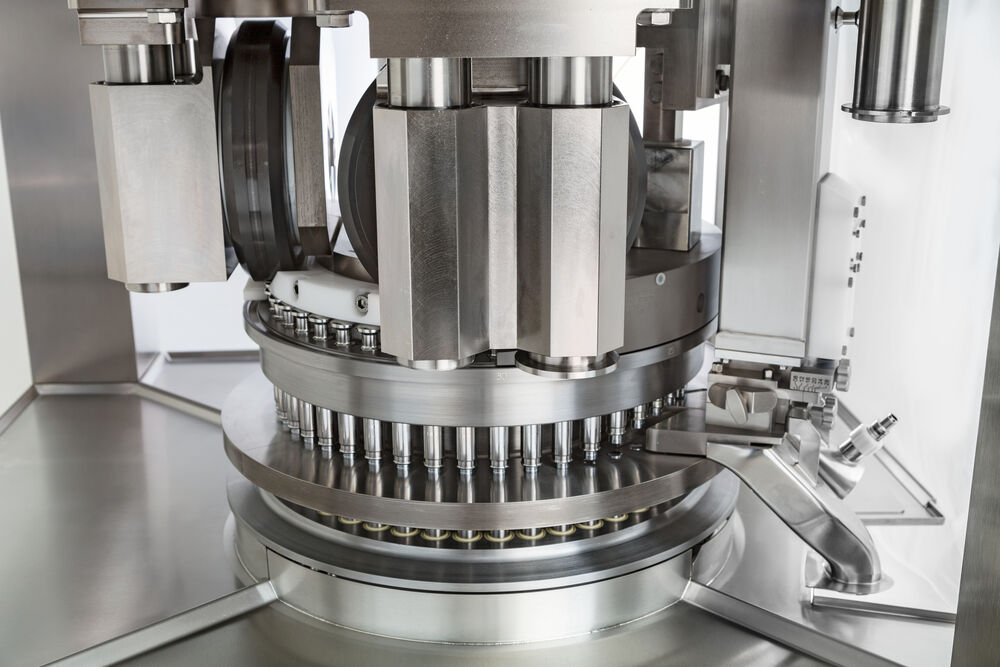
Powerful and efficient: the process chamber of the F20i with Pmax® rotor.
Simpler operation, faster changeovers
High output alone is not enough: manufacturers that frequently switch between products and formats need short changeover and cleaning times. The TRI.EASY Design of the i Series simplifies operation, maintenance and changeovers. “Product-contact parts can be removed in just a few steps and without tools. This shortens the preparation time for the next production run,” explains Lisa Taetz.
Operating the i Series is also simple and intuitive. The Human Machine Interface (HMI) presents important process information clearly. In addition, the integrated “Workflow Operation Wizard” guides operators step by step through standard procedures, saves workflows and provides checklists. This simplifies recurring tasks and helps prevent errors.
Ready for Continuous Manufacturing
In addition to output and ease of use, the i Series offers another strategic advantage: the F20i and F30i can be connected directly to FE CPS, Fette Compacting’s continuous processing system, which brings several process steps together in one compact line. Up to six automated refill systems and loss-in-weight feeding stations precisely feed the starting materials. A horizontal mixer then turns the formulation into a continuous, uniform powder stream. This is followed by a process step that is easily underestimated: the finished blend must reach the tablet press safely and without segregation. For this task, Fette Compacting and the specialists at Dec Group have developed the Fette Compacting Powder Transfer System (FPTS). This vacuum-based technology uses the principle of dense-phase conveying to transport the powder from the mixer to the tablet press in a fully enclosed system. In short, the complex and error-prone transfer steps associated with conventional batch processes are eliminated.
Two transfer paths for the double rotary tablet press
For a single rotary tablet press, one FPTS unit transfers the powder to the tablet press. A double rotary tablet press such as the F30i poses greater demands because two feed systems must be supplied with material continuously and evenly. “With two independent FPTS units, we can distribute the continuously produced powder blend between the two feed systems of a double rotary tablet press. This combines the high output of the F30i with enclosed, controlled material transfer,” explains Lisa Taetz. This also makes it possible to integrate the double rotary tablet press into an end-to-end Continuous Direct Compression line. In this configuration, FE CPS achieves a throughput of up to 800 kilograms per hour. The actual throughput depends on the product, process and selected setup.
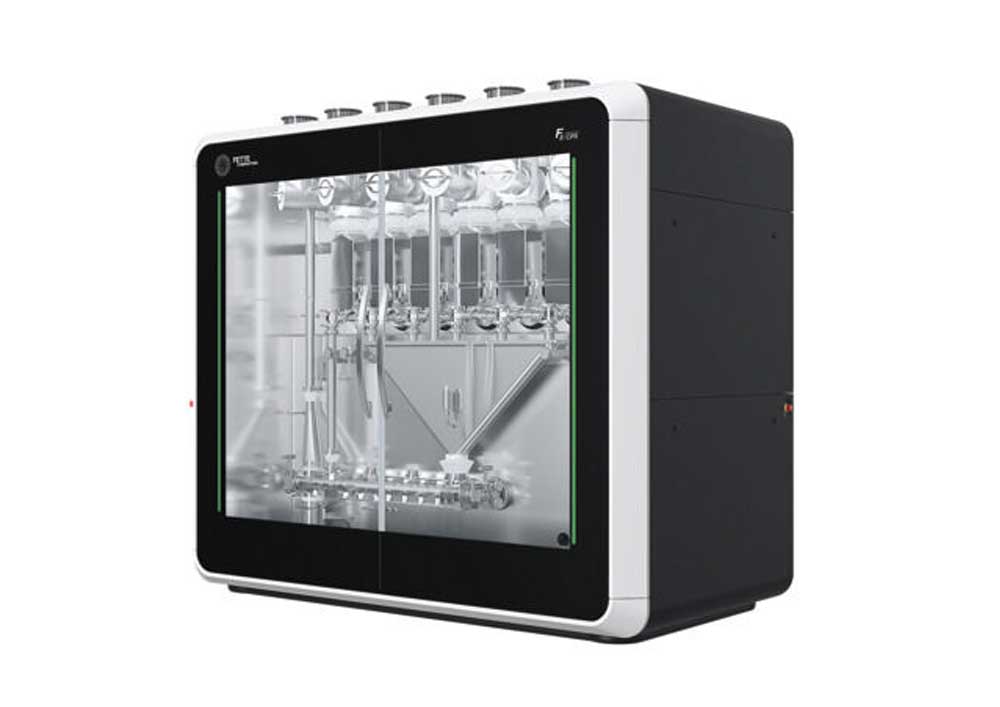
Together with a tablet press and a Human Machine Interface, FE CPS forms a Continuous Direct Compression line.
Monitoring quality directly in the process
Alongside material flow, continuous quality monitoring is particularly important at high throughputs and in Continuous Manufacturing. For this purpose, FE CPS and the i Series tablet presses can be equipped with embedded Process Analytical Technology (ePAT). Sensors based on near-infrared spectroscopy capture quality-related attributes during production. For example, blend uniformity can be monitored before tableting, while another sensor in the process chamber checks tablet homogeneity shortly before discharge. The result: deviations become visible at an early stage, can be investigated in a targeted manner and, if necessary, compensated for as part of a control strategy.
A step-by-step transition to Continuous Manufacturing
“The transition to Continuous Manufacturing does not have to begin with a complete conversion. Pharmaceutical manufacturers can initially use an F20i or F30i in batch operation and later add technologies such as FE CPS, FPTS and ePAT,” explains Lisa Taetz. Processes can likewise first be developed using smaller quantities of material and then transferred to higher throughput ranges.
The i Series therefore combines two requirements that are becoming increasingly important in tablet production: high output in current operations and readiness for future production concepts. The special FPTS configuration extends this approach to the double rotary tablet press. A high-output tablet press can thus be expanded step by step into an end-to-end Continuous Direct Compression line.
